Tree guys

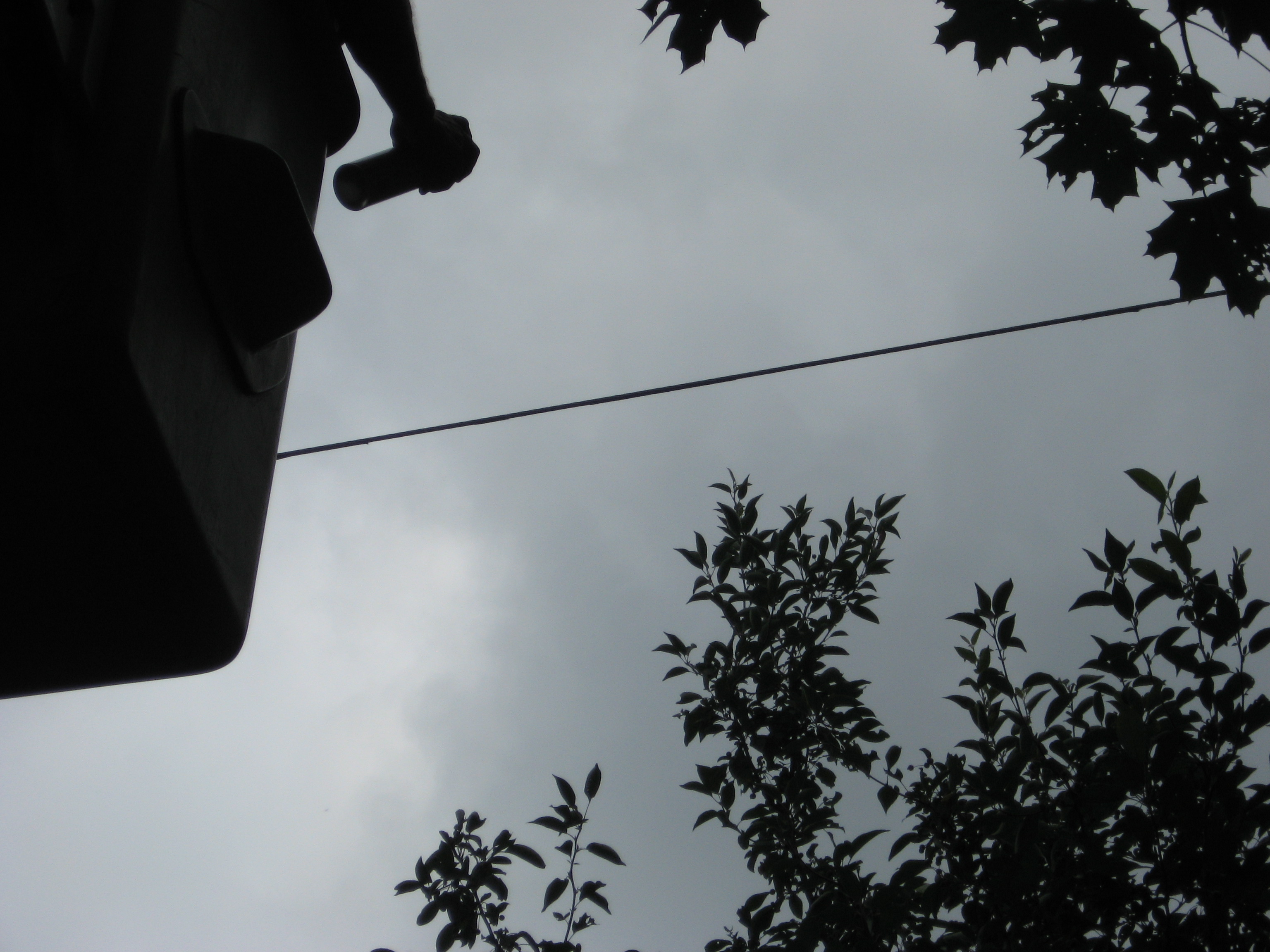
In preparation for hurricane season and winter, the electric company has hired a tree service to cut back branches from the top two wires on utility poles around town. A two-man crew was here the other day on a side street that runs parallel to our backyard. I was home, so hearing the hubbub, I went out to chat them up, offer iced water, and make sure they didn’t mangle the crown of our beloved Japanese umbrella pine. Turns out they did a very nice job, prudently selecting branches and cleaning up afterward. The fellow in the basket of the cherry-picker got a wake-up call from a nest of yellowjackets atop our crab apple tree. Impossible to see from the road, and he didn’t spot it up high until a squadron of bees emerged. He made it down with only one sting.

Out came the spray. One of our neighbors is deathly allergic to bee stings, so I was glad to see the nest’s demise.

It took two spray attacks over consecutive days to knock out the nest of yellowjackets.

Turns out yellowjackets aren’t bees but wasps. In the neighborhood where I grew up, kids called them yellowjacks. I didn’t experience much bee drama as a kid. The only encounter worth noting was the discovery of a giant hornet nest–about the size of a basketball–on the back of the house across the street from us. Word spread fast. All the kids gathered, and the means of destruction was settled on rather quickly: water balloons. A dozen overfilled, unstable water balloons were volleyed at once. The nest exploded in a sodden mass, and a veritable cloud of hornets flew out. Everybody got stung as we ran away and scattered, waving our arms and screaming like maniacs.


Posted in Uncategorized | Leave a comment

“The first breath of autumn….”

That’s a word I hesitate to write this time of year, when summer is in full stride, the turf grass dormant, only the indomitable weeds plump and green, the compacted soil at the edge of the driveway as dense as granite, and the end-of-the-day sun at the beach so warm and comforting it deceives you into thinking that your skin will feel this way forever. Alas, it won’t. So it goes. Each passing day of August brings a postscript: one morning you will awaken, and you will know that summer’s over, the cool tingle of fall on your cheeks, a feeling so crisp and immediate that its sensation can never be undone no matter how hard you try to pretend it away.

I consider this after reading a passage from J. L. Carr’s extraordinary short novel,  A Month in the Country, first published in 1980. I have a lovely, albeit paperback, edition published in 2000 by The New York Review of Books (courtesy of the Robert L. Caruthers Library at the University of Rhode Island), with a hilarious, touching, and indispensable introduction by Michael Holroyd, whose latest book, incidentally, is reviewed today on the cover of The New York Times Book Review. Here it is:

“Just before I bedded down I stood at the window. And he was right–the first breath of autumn was in the air, a prodigal feeling, a feeling of wanting, taking, and keeping before it is too late.”

Born 1912, died 1994. When asked to define himself, he replied: "James Lloyd Carr, a back-bedroom publisher of large maps and small books who, in old age, unexpectedly wrote six novels which, although highly thought of by a small band of literary supporters and by himself, were properly disregarded by the Literary World." (google image)

The novel is infused from first to last with the warmth of rueful serenity. Written in the first person, it the story of a battle-weary World War I veteran, a talented young art historian and technician, who arrives in a small village in rural England where he has been hired to uncover and restore a Renaissance-era mural on the wall of a decrepit church. His time there spans a month, during which he makes friends, makes acquaintances, flows with the new rhythm of daily life, and, of course, falls in love. But falls in love in a way that is entirely his own, a love so heartbreakingly sweet and fragile, so poised at the edge of impossibility, that it fills your own heart with tangible joy and sadness. The narrative voice swells from the memory of the young man now old, looking back across the decades, wondering at what was, is, and might have been. As the image of the large, dramatic mural slowly comes into view from behind a centuries’ old wash of limestone, candle grease, and human exhalation, the narrator gradually finds himself identifying with the unknown artist, both his hand and his temperament, and this increasing artistic awareness dovetails wonderfully with the awareness of his new self, reborn after the horror of war through the balm of social intercourse and conversation, the renewing power of art and of a woman’s beauty.

Well. There it is. A book worth reading. Permit me to leap from macro to micro, and share a few of the words and phrases that compelled me to the dictionary while reading A Month in the Country. Like Shakespeare, Carr purposely peppers his story with words that are long gone from use, not only to tie it to an earlier time but also to deliberately separate it, almost physically, from the now time. It’s a way of saying, among other things, that all times are one time. Here we go:

the straw fish-bass
the narrow gate’s sneck
some Tactarian incumbent

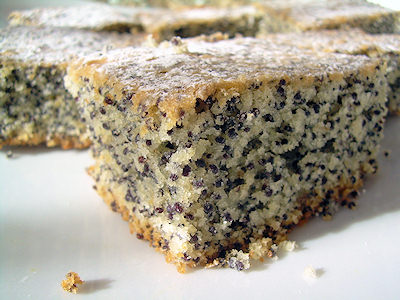
seedcake

Poppyseed here, carraway seed in other recipes. I have yet to make this. (google image)

a largish oval escutcheon
sprinkle a little Keating’s once a week
kirtles and snoods
mullion
Bannister-Fletcher
I wouldn’t fancy being in the dock if he was the beak

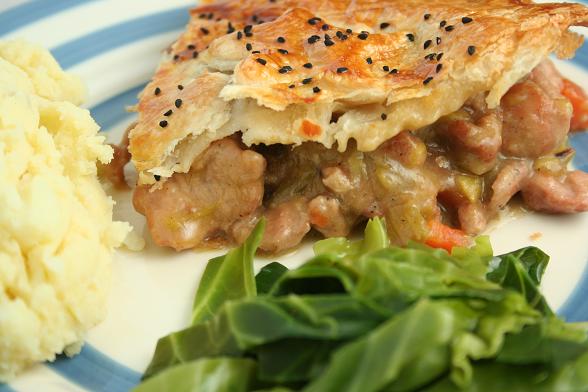
rabbit pie

Despite the inclusion of the beloved leek in this recipe, there isn't enough money in the world.... (google image)

The Forgotten Garden
The Coral Island
Children of the New Forest

A platelayer crossed, pushing his bike along the path to the station

these fitments

I lit a Woodbine

If the Huns didn't kill you, these would. (google image)

the Wesleyans
humping his estovers
hedges and spinnys

I will allow the so inclined to pursue these delectable phantoms on your own time. Me, I’m going to hump an estover by the spinny, after which I’ll light a Woodbine.


Posted in Uncategorized | Leave a comment

Approaching, we grew apprehensive

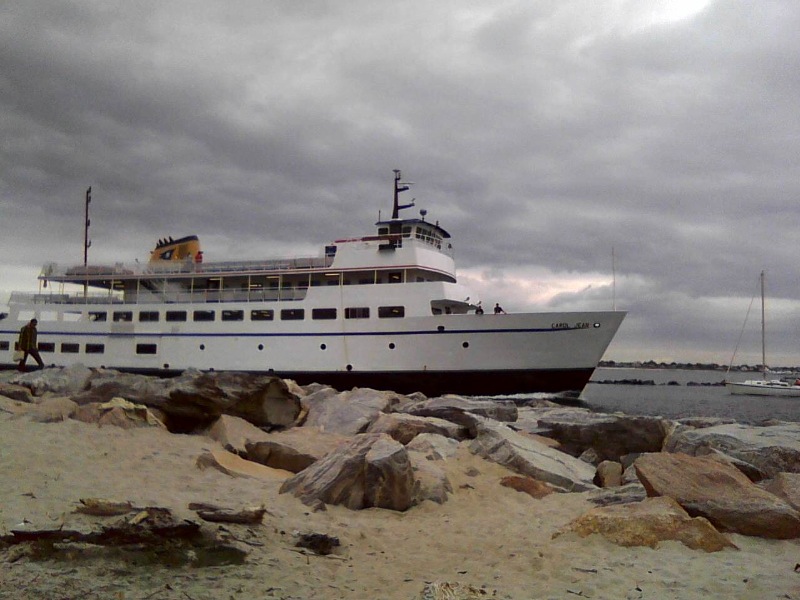
Earlier this summer, Nonnie and I were walking at East Matunuck State Beach, our weekly routine year round. There are few better places to carve a path in the sand. The same sky and the same ocean never look the same, and the time of day and season change the interplay of wind and sun and cloud and shadow in infinite ways. Head east toward the houses on perilous perch, the breakwater, the channel that cuts between Galilee and Jerusalem. It’s good luck to reach the breakwater rocks just as the Block Island ferry

Heading to Block Island

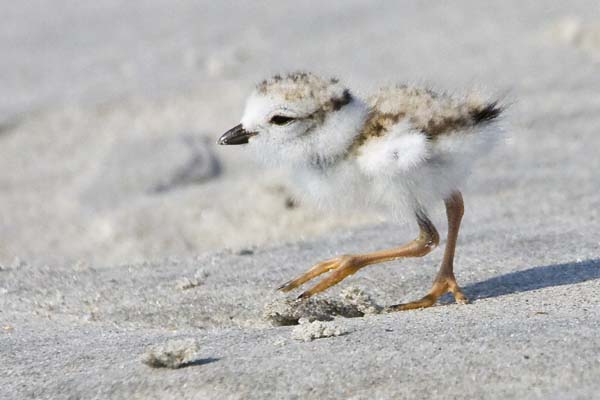
passes by. Touch a rock with the tip of a foot, turn around, and head west, where the Ocean Mist beckons from around a bend. The west end in early summer is where you’ll see the partitioned section protecting the piping plovers. Stand a while at the braided nylon rope and let your eyes focus to the pale grays of stone and sand, and you’ll see a plover baby, a ball of fluff on toothpick legs, scooting across the arid plain.

Heading for the water (google image)

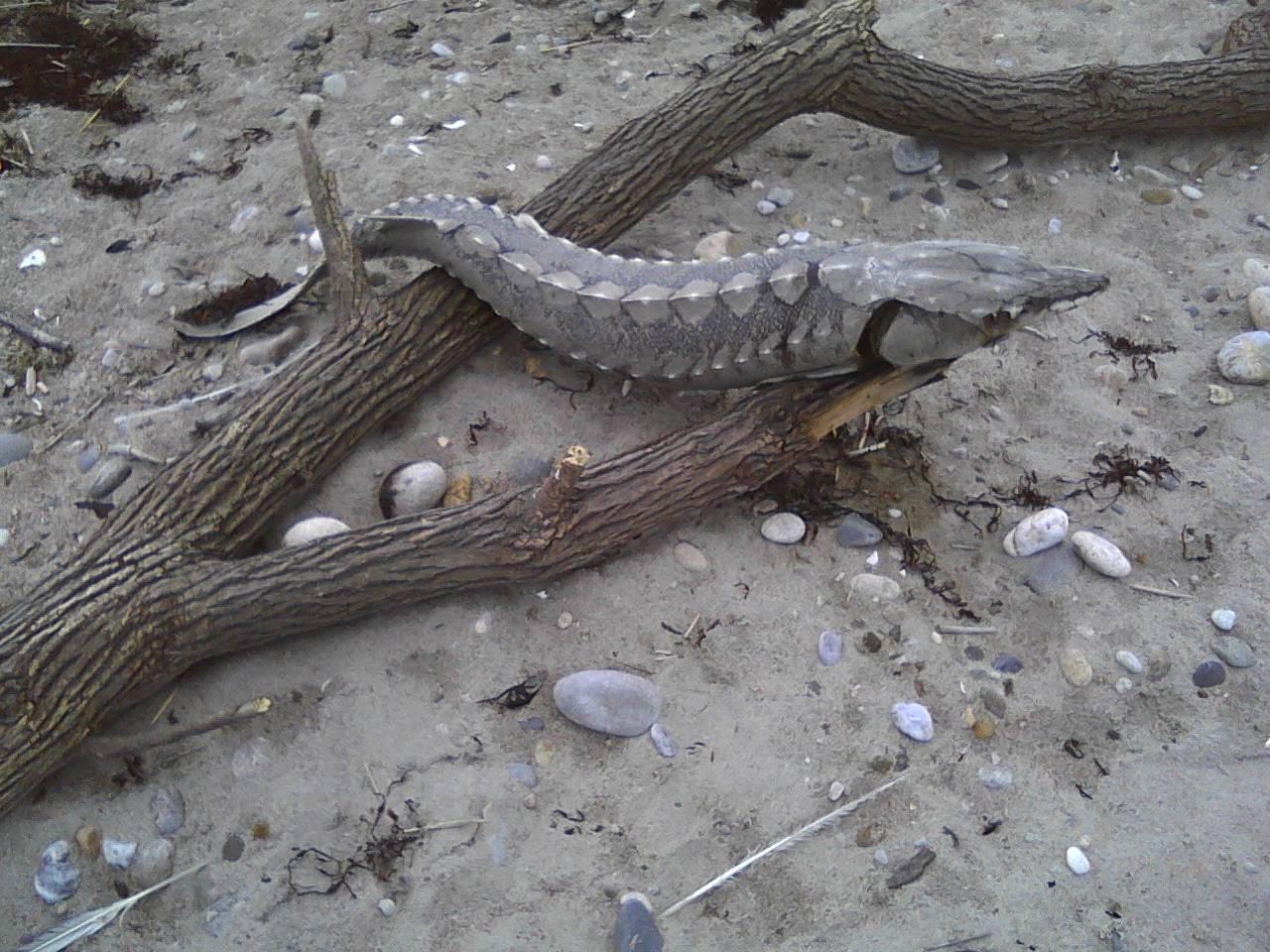
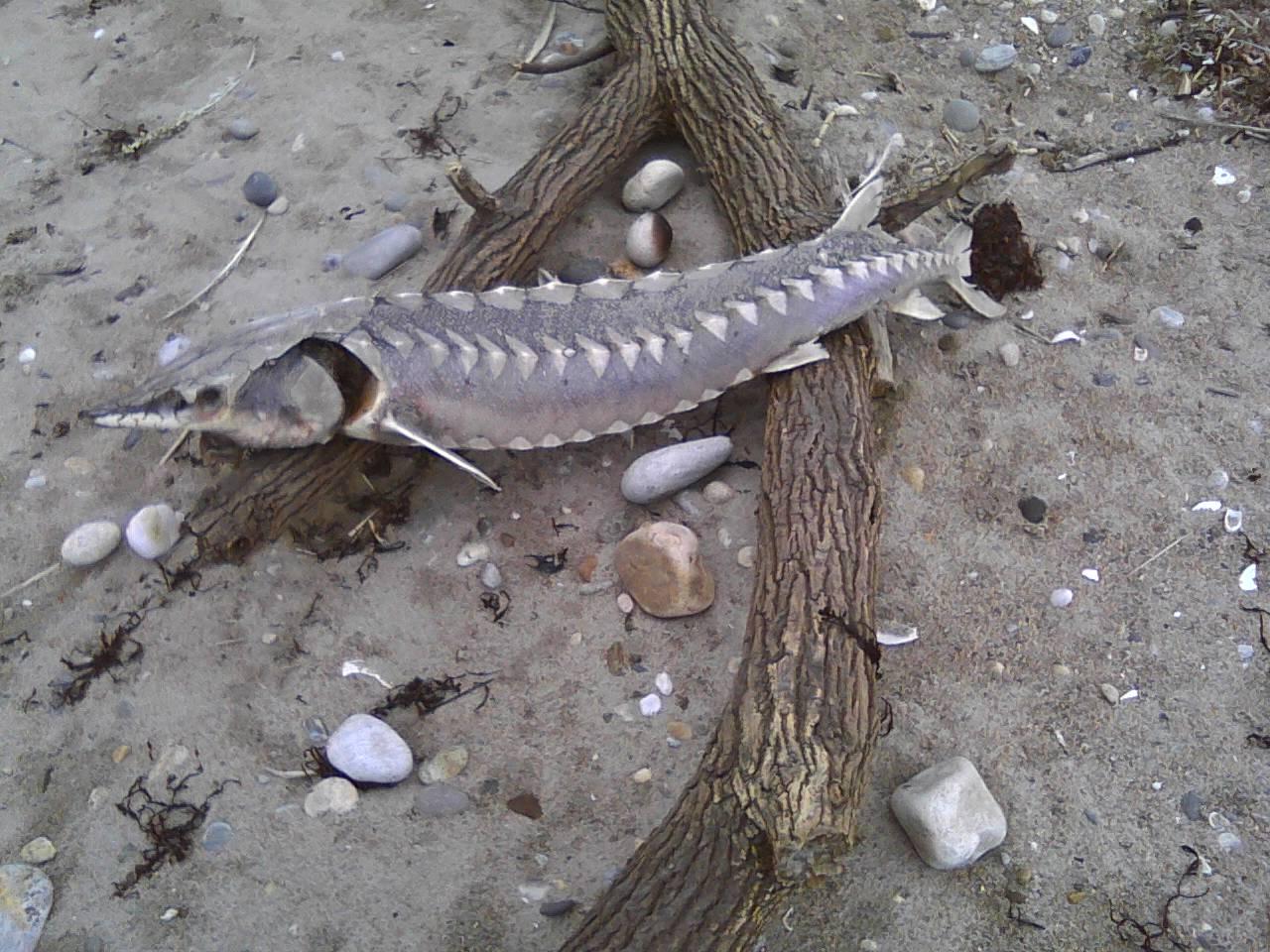
It was walking by the west end earlier this summer when we saw an oddly colored and oddly shaped object draped, purposefully, it seemed, on a length of driftwood. Approaching, we grew apprehensive. A bizarre, unsettling sculpture? What the…. It looked organic. What is that? It was a fish. Is that a fish? What the….

View from the south

I took two pix with my cellphone, later sending them to Nick’s iPhone so he could e-mail them to my Mac at home. (Thanks, Nick!) Visuals recorded, we took a close look at what we were seeing. About four and half feet long. Armor-like plates rather than scales. Bony protuberances aligned in rows. Nightmarish snout. Downright prehistoric, we agreed.

View from the north

Once home, I knew we could find out what this critter was through the University of Rhode Island, which has a terrific Marine Biology program. I fired off an e-mail to Professor Jacqueline F. Webb, the program coordinator. Here’s her reply to what we sent:

“Absolutely a sturgeon! Likely Atlantic – you can tell from the shape of the tail and the configuration of the plates on the body.  I get a call about once a year about a sturgeon on the beach. They are locally occurring marine/freshwater migrators of sorts.”

I also wrote my friend Laura Chavanne, in Boston, a keen student of “dudes.” She replied immediately:

“AWESOME! Congratulations on this important scientific discovery!”

A few days later I wrote back to Professor Webb:

“I’ve been reading about the sturgeon since we last corresponded.  Little changed in 200 million years? They must be doing something  right, and consistently. So they can manage to create hybrid spawn across genera? As an  English major, I’m little versed in this curious aspect of reproduction. Do other fresh water and salt water dwellers manage
this? An interesting evolutionary ability. Yet they mature late in their life span–so there must be plenty of food for them, and in locations relatively free of predators. Except for  humans, who have hurt them badly. Also interesting. As for polyploidy–well, I’m going to have to spend some time with that concept. It’s past my understanding at the moment, but I’ll crack that shell in time.

“Back to English: I don’t know if you’ve read The Girl with the  Dragon Tattoo and the two sequels, or seen the three motion pictures  (the movies I recommend; the books not so much), but there’s a parody in Sweden called The Girl with the Sturgeon Tattoo. I predict the sturgeon is about to go mainstream!

Noomi Rapace, exquisite as Lisbeth Salander, in the splendid Swedish films based on Stieg Larsson's trilogy (google image)

“Our species was anadromous, I presume. Where might it have come from? Any ideas? Thanks so much for getting me into this!”

Here was her reply:

“Yes, they are quite ancient and interesting. Here’s a site I found that addresses your questions: http://www.ct.gov/dep/cwp/view.asp?A=2723&Q=325960

“Anadromy – the site above indicates that the only river that has a normally spawning population of Atlantic sturgeon is the Hudson, so the one you saw may have been looking for a river, but didn’t succeed.

“Hybrids across genera – rare among fishes (and in all animals), especially since chromosome numbers vary among different species (that messes things up when egg and sperm meet).

“Polyploidy – most animals have one set of chromosomes from mom, another from dad, so they are considered 2n. A polyploid organism is 3n or 4n due to chromosome duplication some time in their evolutionary history – some salmon are polyplid, too.

“For all that you ever wanted to know about fish – to search by common or scientific name, see: www.fishbase.org (approved by fish people). Also, the RIDEM site has a good series of pages on fishes of Rhode Island. See: http://www.dem.ri.gov/programs/bnatres/fishwild/index.htm

“Hope that helps!”

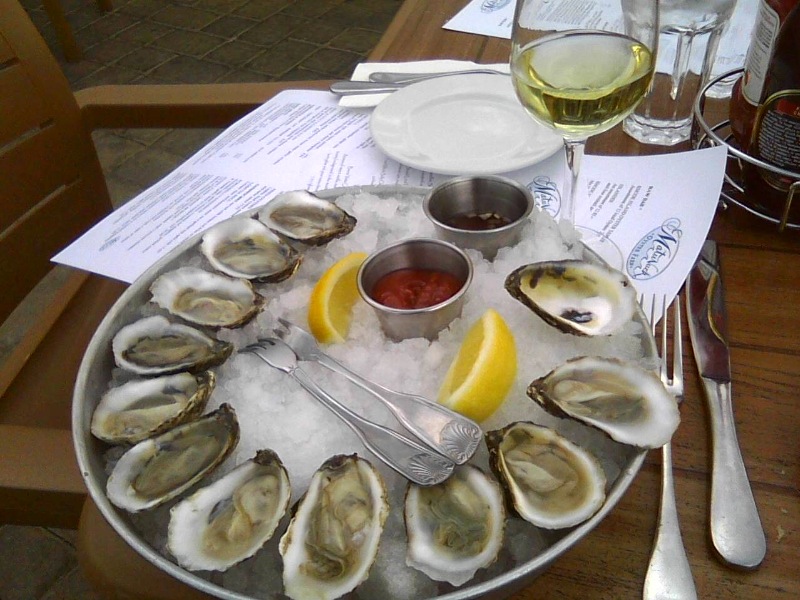
Indeed, it helps. Mystery solved. Thanks so much, Professor Webb! I will treat you to a dozen raw bivalve mollusks!

The Matunuck Oyster Bar, on Succotash Road, gets it right

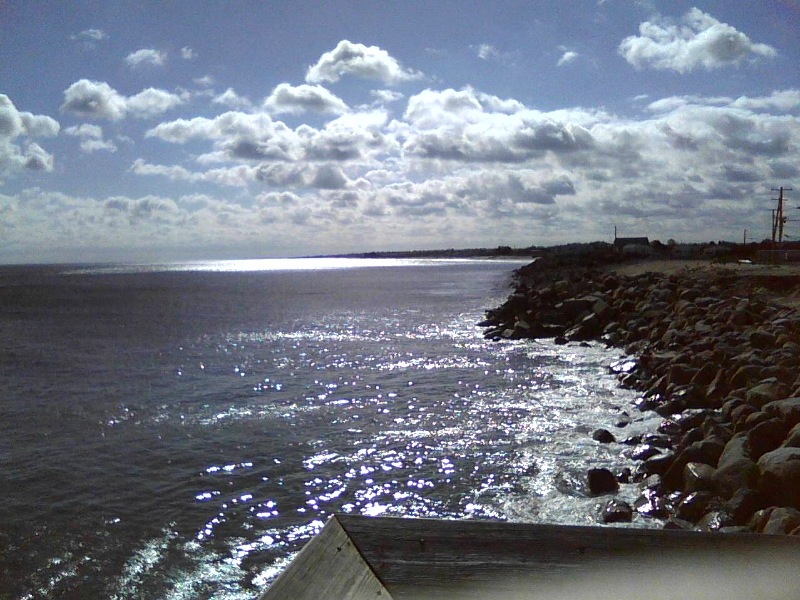
By the way, having mentioned the Ocean Mist, here’s a recent pic taken from the deck, looking west. What’s not to love? A great big thank-you to daughter Liz for e-mailing my cellphone pix of the Ocean Mist, Matunuck Oyster Bar, and the Block Island ferry via her iPhone.

Sigh

Posted in Uncategorized | 1 Comment

Trust the Artist

Made a birthday cd for my friend Jeff Silva, a grand lad. Here’s the set list:

1)    Oh My Heart                               R.E.M.                                                                       3:21
2)    Rain Rain Go Away                   Lee Dorsey                                                               2:48
3)    Jockey Full of Bourbon            Joe Bonamassa                                                        5:22
4)    St. Louis Blues                           Flamin’ Groovies                                                     2:38
5)    Got a Ukelele                              Loudon Wainwright III                                         2:39
6)    Seeing Black                               Lucinda Williams                                                    5:14
7)    Falsehood                                    Vijay Iyer, Prasanna & Nitin Mitta                     6:39
8)    Ride Me High                             J.J. Cale                                                                    3:39
9)    I’m a Hummingbird                  Eels                                                                            3:14
10)  Calypso Minor                            Abdullah Ibrahim & Ekaya                                  6:24
11)  Used to Be a Cop                        Drive-By Truckers                                                  7:04
12)  Firesuite                                      Doves                                                                        4:36
13)  Champion Angel                        The Low Anthem                                                    5:34
14)  Universal Applicant                  Bill Callahan                                                            5:53
15)  Country Boy                                Miracle Legion                                                       4:46
16)  The High Road                           The Feelies                                                              4:27
17)  Put It There, Pal                         Bing Crosby & Bob Hope                                     1:44
18)  Please Don’t Let Our Sweet Love Die      Daily & Vincent                                   3:44

The studio recording of the Wainwright track, a charming tune, makes a sly reference to Jerry Lewis, who is–yes, I’m in le camp français–a motion-picture genius. If you are in doubt, kindly invoke a directive I concocted, one that has never let me down: Trust the Artist. So check out this short clip, from The Bellboy. Here Lewis’s character becomes a force that, as in cartoons, can alter reality through the strength of the imagination. Remember how the Coyote runs off a cliff and is suspended, not falling until he looks down and questions his belief? Same fountain sustains Lewis.YouTube Preview Image Yes, he’s overbearing and obnoxious and inconsistent. Who isn’t? This won’t be the last we hear of him here, but I’ll give you plenty of warning.

The Low Anthem, a wonderful Rhode Island-based band, here ascends into Neil Young territory with “Champion Angel,” a song that is great to sing along with while you’re doing the dishes.YouTube Preview Image My sister Carole taught me the joy of singing while washing and drying in our youth. She’d wash, I’d dry. This was how I came to understand the concept of harmony, and then to execute it, by singing along with her in the kitchen and having each note separated and explained. It was The Everly Brothers who provided the portal for me, via Carole. The first song that allowed me the conceptual breakthrough was “All I Have to Do Is Dream.” Surely, they were channeling Apollo.YouTube Preview Image Later, as my affection for harmony developed, I found access to third and fourth parts. I could drive across Canada singing along with Phil and Don, and not know what I was doing until the trance broke in Vancouver.

Well, I can’t let the last link be a restaurant. Looking through video of Lee Dorsey online, I found this gem, from a 1967 performance at the Culture House, in Finland. YouTube Preview Image

Posted in Uncategorized | Leave a comment

Alas, poor Glyptemys insculpta

An irresistibly potent blend of sad, cute, and fascinating

Coming back from an errand in town today, this caught my eye while heading west on Saugatucket Road, on the left, just before the intersection with Route 108. A lost turtle. Good heavens. The neighborhood’s telephone poles regularly sport new posters for lost cats, especially around Upper College Road, Biscuit City Road, and South Road. The coyotes in the area–and, increasingly, the fisher cats–enjoy the local buffet. But a lost turtle?

I got home and checked the 610 area code: eastern and southeastern Pennsylvania–the old Rust Belt towns of Allentown, Bethlehem, and Reading, as well as portions of Philadelphia. Curious.

I imagine a child up here visiting her grandparents for a week in summer. She brings her beloved pet turtle. Name? Maybe Slowpoke. Or Carapace. Distracted for a brief moment by squabbling blue jays up above, she loses track of her turtle in the tall grass by the hedges.  Tragedy. Tears. Her grandmother makes a blueberry pie, the child’s favorite. Her grandfather fires up the Mac and the pair designs a poster. He recommends an assertive sans serif font. She has a picture of the turtle on her facebook page. They walk hand in hand around the neighborhood and put up the posters, angled just right for passing motorists. You never know–maybe someone will find her, he says reassuringly. The reward would be a silver dollar, from her piggy-bank, one given to her on her birthday by the grandparents from whose very backyard the turtle escaped.

I called the number, left a message, and in five minutes got a call back. The female voice was rather young sounding, so I asked if she had her parents’ permission to speak with me.

“I’m thirty,” she said.

Her name is Aviva Moster. The turtle’s name is Pumpkin. She also has a Russian tortoise named Sugarlump. She moved up here from Philly, hence the area code on her cellphone.

“She’s usually inside, but I built a little pen outside for her and my tortoise,” she said. “They try to get out sometimes. But they were sitting in the pen, and then I went inside for three minutes, and she got out. This was on July 12, about 6 p.m. I think she’s gone. I put the signs up yesterday.”

Pumpkin is eight years old. Aviva adopted her in New York City through craigslist. The previous owner didn’t want her anymore. I asked about Pumpkin’s personality.

“She was mean and curmudgeonly,” she said. “She didn’t like to be around anybody else. She wasn’t nice to me or my tortoise. So I thought of her as my teenager. I wouldn’t say she liked me, but I loved her.”

Pumpkin’s favorite meals were lettuce and red grapes.

“The only time she liked me was when I fed her grapes,” Aviva said. “She would eat them out of my hand. Wood turtles live to be in their forties. I expected to grow old with her.”

Posted in Uncategorized | Leave a comment

Troglodytes aedon redux

Why should the wee chap called the house wren belong to the family Troglodytae? I thought a troglodyte was a slang word for a caveman, like good old slope-browed Alley Oop, or any pre-homo sapiens humanoid. Urban Dictionary is neither illuminating nor entertaining for the entry, though Free Dictionary refers to a troglodyte as a “curmudgeon attached to an obsolescent computing environment.” Ha! That works.

But back to the wren. The new birdhouse in our backyard is home to a second family of

Une maison grande pour des oiseaux dans l'amour

wrens this season. Two days after the four siblings in the first crew flew off, another wren started to clean out the nest, make one of its own, and start a family. I built the house so that the north side of the sloping roof is attached to the frame with velcro, making for easy annual cleaning by this humanoid. I’ve been tempted to lift off the roof to get a pic of this second fam but have resisted.  I don’t want to stress the poor guys by leering in like The Amazing Colossal Man.

The first birdhouse was a kit given to son Nick by his aunt, my sister Kathye. A great gift. Nick was about seven, put it together with hammer and nails, and painted it blue and white. He even crafted a faux chimney for it. It lasted seventeen years, finally demolished in the fall of 2010 by a woodpecker that used it for warming up exercises. The front and roof collapsed inward. Time for a new one.

I measured what was left of Nick’s house and made this one about twenty-five percent bigger. Painted it red and white. Put it up in mid spring of this year. The For Sale sign came down in less than a week. And, of course, the occupant was a house wren, the little bullies of the backyard bird world, noisy, fast-flying bundles of energy whose incessant high-pitched trills and squeaks will drive you bonkers if you can’t learn to tune them out. The male announced possession by perching on the roof and singing loudly and repeatedly for a few days, then the nest building began, with endless trips in out of the house with small twigs and dried stems. Some of the longer sticks proved a problem. Imagine Buster Keaton trying to get a ladder through a doorway, the wrong way. The poor wren is perched on the little dowel I installed under the hole, and he’s got a four-inch twig left to right in his beak and can’t get it into a one-and-a-half-inch diameter hole. It took him the better part of a day to figure it out, finally going inside the house to pull in the rest of the twig.

Seems that the male starts the nest as a way to attract the female. And sometimes the male leaves before the babies are fledged. I can’t tell male and female apart. No matter. One day the endless back and forth trips to the house are punctuated with a cheeping sound so high and fragile it’s almost imaginary. Yes, it’s the babies. They’ve hatched and are feeding. It happens so fast! The female makes a thousand trips a day, I’ve read, to feed the brood. Inchworms, small caterpillars, and grasshoppers. She finds a seemingly endless supply in Nonnie’s gardens, especially under and amid the low-hanging branches of the azaleas.

Heading out for another mouthful of Biston betularia

One June morning about 6:30, as we stared out the kitchen window silently before separating for the day’s work, I saw an odd movement at the birdhouse hole. Nonnie’s got the distance vision; I’m the closer upper. So I put down the coffee mug and grabbed the binoculars. “It’s a baby,” Nonnie said. “It wants to come out.” Time stopped. The two us entered a trance of shared attention and wonderment. For the first time, we would see a brood take flight.

What does it take to be the first bird to approach that hole from the inside? It’s impossible not to watch this miraculous process and attribute character traits to each bird. It’s dark and crowded in there (despite the architect’s generous design), none too sanitary, and increasingly noisy. The hole means light, air, food. The wing muscles must be busting with potential energy, just wanting to stretch out and achieve lift. So compulsion merges with need, and merges with desire, something deep in the cells compells, and the first little dude chins it up to the hole and sticks out his head.

“Holy crap,” the male humanoid says, capturing the fragile poetry of the moment.

His head is out, then his neck, then part of his body. Then a foot, followed by a leg! In a bizarre calisthenic, One looks like I once did as a kid trying to get into the bathroom window after locking myself out of the house. You can get stuck with this move. One’s foot reaches for the dowel perch, swings back and forth trying to snag it. Foot clamps tight. Now One gets scared–or seems to. One freezes. Look around. Now what! He (or she) tries to duck back inside, but his feathers fan outward awkwardly like an umbrella turned inside-out in a gale, keeping him from the safety of the house. Now he has to leave, and he doesn’t seem too happy. Ever so slowly, he wiggles his body outward, that first foot still clamped tightly to the perch. He’s out! I don’t want out, he says, as his other leg, now fully exposed, swings around and upward to grab the bottom the hole. What a spectacle! One leg is at twelve o’clock, one leg at six o’clock, and in between a bird unsure, wings flapping, head turning this way and that. A visual memory jostles loose: Bean, on the diving platform. (Long version. Short version.) He releases the top leg, and swings downward like a pendulum to a porch-like lip that extends from the base of the house. He’s out and on the ledge. Now Two has stuck his head out and is squawking at One to beat it!

In a flash, Two is out of the hole and flying away–a split second, as if no need for thought and decision. C’mon, One! And as Three sticks out his head, One flies off. Go, One! Three comes out quickly but lingers on the perch. He rather likes the view. But Four comes out and pushes Three off the perch, forcing him to take wing. Four plops down rather awkwardly on the porch, looks about, and flies away.

Whether the male is still around we can’t tell, but there at least five wrens in the backyard now, all making noise, all flying like maniacs, dive-bombing each other, and landing in the azaleas and viburnum. By afternoon, they were gone. These dramatic leave-taking took about fifteen minutes. We agreed it belonged with the Splendid Unforgettable Moments. Thrilling.

So why the Troglodytae family name? Beats me. I’ll have to get back to that.

Incidentally, Alley Oop was created in 1932 by illustrator and cartoonist V.T. Hamlin, an interesting guy. His middle name was Trout. He joined the Army at 17, serving with the American Expeditionary Forces in France during World War I. While recovering from a poison gas attack, he started illustrating the letters that his fellow soldiers were sending home. One thing led to another, as is destiny’s wont.

Posted in Uncategorized | Leave a comment